
How to run a Christmas raffle for your charity
By the RaffClub team · · 6 min read
To run a Christmas raffle for your charity, choose between registering a small society lottery with your local council and running it as a prize draw with a free entry route. Both let you sell digital tickets online and at your Christmas events, so supporters can take part wherever they are.
After that, it's mostly organisation. This guide follows the order you'll need, using the rules for Great Britain from the Gambling Commission. It's general information, not legal advice.
Which type of Christmas raffle should your charity run?
You have two options. A small society lottery means registering with your local licensing authority, and suits charities that want a straightforward paid raffle. A prize draw needs no registration, but you must offer a free entry route. Both can sell digital tickets online, in advance and at your events.
Here's how they compare, based on the Gambling Commission's guidance on small society lotteries and free draws.
| Small society lottery | Prize draw | |
|---|---|---|
| Registration | Register with your local licensing authority (£40, then £20 a year to renew) | None |
| When tickets can be sold | Any time before the draw | Any time before the draw |
| Online sales | Allowed | Allowed |
| Who can buy | People aged 16 and over | Over 18s, in line with the government's voluntary code |
| Free entry route | Not needed | Required, usually by post, promoted as clearly as paid entry |
| Limits | Total ticket sales under £20,000 per lottery and £250,000 a year, top prize no more than £25,000 | Lottery limits don't apply |
| Paperwork afterwards | Return to the council within three months of the draw | No council return |
When should you start planning a Christmas raffle?
Start at least six to eight weeks before your draw. That leaves room to register with the council if you need to and to ask local businesses for prizes before their own Christmas rush. You'll also get a few paydays to sell across. For a draw in mid-December, that means getting going in late October or early November.
A rough timeline looks like this:
- Six to eight weeks out: choose between a small society lottery and a prize draw, and apply to your council if you're registering a lottery.
- Five to six weeks out: send prize requests and confirm what's coming in writing.
- Four weeks out: set the ticket price and draw date, and write short terms and conditions.
- Two to four weeks out: sell, and keep posting prize updates until the closing date.
- Draw week: close sales and run the draw.
Registration times vary between councils, so check yours early. Don't sell tickets for a small society lottery until your registration is confirmed.
How do you register a small society lottery?
You apply to the licensing team at the local authority where your charity's main office is, usually your district or borough council. The fee is £40, with a £20 renewal each year. Once you're registered, the Gambling Commission's small society lottery rules apply to every raffle you run under it.
At least 20% of the money from ticket sales has to go to your charity's purposes. The other 80% at most can cover prizes and costs. You must take payment before anyone is entered.
How do you get prizes for a Christmas raffle?
Ask early and ask locally. Pubs, restaurants, hairdressers, garden centres and family businesses are often happy to donate a voucher or experience in return for a mention. Write to them by early November and say exactly what the money is for. Confirm every donated prize in writing.
A few things make Christmas prizes easier to manage:
- Put one standout top prize first in all your marketing. People buy tickets for the prize they'd most like to win.
- Check voucher expiry dates and any restrictions before you list a prize.
Can you sell Christmas raffle tickets online?
Yes, if your raffle is registered as a small society lottery or run as a prize draw. The Gambling Commission allows small society lottery tickets to be sold online, by phone, door to door or face to face. A prize draw needs no registration at all.
Selling online lets supporters who can't make your Christmas fair still take part. When you run your raffle on RaffClub, your charity stays the promoter. The platform takes ticket payments and gives each buyer a digital ticket, so every entry is recorded.
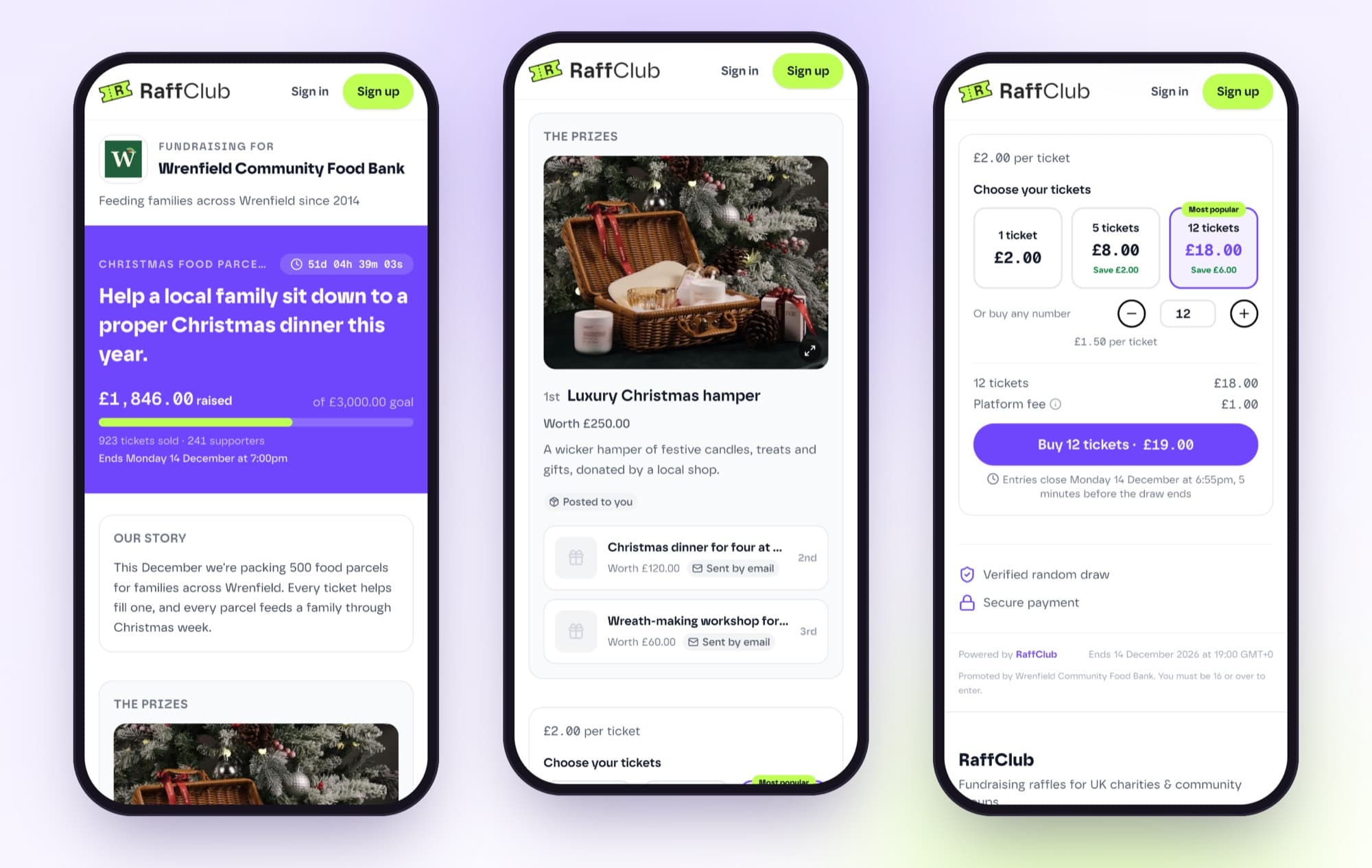
Selling online as a prize draw
If you'd rather not register a lottery, you can sell your Christmas raffle tickets online as a prize draw. There's no licence or council registration, and supporters buy digital tickets in exactly the same way. The one requirement is a free entry route, usually by post, which the Gambling Commission's guidance on free draws says must be:
- no more expensive or less convenient than buying a ticket
- shown as clearly as the paid option
- treated the same as paid entries in the draw
In practice, very few people use it. Across thousands of prize draw entries on RaffClub, only four have come through the free postal route. People entering a charity draw are usually there to support the cause, so the free route keeps your draw compliant without a noticeable effect on what you raise.
RaffClub supports prize draws with a free postal entry route built in and sorts any postal entries for you. Prize draws are open to over 18s, in line with the government's voluntary code for prize draw operators.
How do you draw the winners fairly?
Announce the draw date and method before you start selling, then stick to them. Use a random method that gives every ticket the same chance, and draw in front of witnesses or on a live stream. Contact winners promptly and publish the results so supporters can see the draw was fair.
Say in your terms what happens if a winner can't be reached.
RaffClub looks after all of this for you. Draws are completed through a third party, fully verified and traceable.
What should you do after the draw?
Get prizes to winners quickly, then thank everyone and tell them what the money will pay for. If you ran a small society lottery, send your return to the council within three months of the draw. Keep your sales records and the list of winners in case anyone asks.
A short thank you post naming your prize donors (with their permission) goes a long way. It's also the easiest way to get the same businesses to say yes again next Christmas.
Christmas raffle FAQs
Do you need a licence to run a Christmas raffle?
No. A small society lottery is registered with your local council rather than licensed by the Gambling Commission, and a prize draw with a free entry route needs no registration at all.
Can children buy Christmas raffle tickets?
No. Small society lottery tickets can only be sold to people aged 16 or over, and prize draws on RaffClub are open to over 18s, in line with the government's voluntary code for prize draw operators.
Can you claim Gift Aid on raffle tickets?
No. HMRC's Gift Aid guidance says a payment for a raffle ticket isn't a gift, because the buyer gets the right to enter the draw in return. You can still invite supporters to make a separate donation, which may qualify.
Do the same rules apply in Northern Ireland?
No. Lotteries in Northern Ireland come under different law, the Betting, Gaming, Lotteries and Amusements (NI) Order 1985, with the Department for Communities responsible for policy. Check with your district council before running a raffle there.
Run your Christmas raffle on RaffClub
If you'd like to sell tickets online this Christmas and leave the cash tin at home, you can start your raffle on RaffClub. Or book a short demo and we'll show you how it works for your charity.
Sources
- Gambling Commission: Types of lottery you can run without a licence
- Gambling Commission: How to run a fundraiser with lotteries or raffles at events
- Gambling Commission: Fundraising and lotteries at events
- Gambling Commission: How to run a small society lottery
- HMRC: Charities detailed guidance, chapter 3 Gift Aid (section 3.4.6)
- GOV.UK: Gift Aid donation claims for charities and CASCs
- Licensing Act 2003, section 175
- Department for Communities (NI): Betting, gaming, lotteries and amusements
- Gambling Commission: Free draws and prize competitions
- GOV.UK: Voluntary Code of Good Practice for Prize Draw Operators
- Gambling Act 2005, Schedule 11 Part 1